
Executive summary
I run Tradespace, a company that builds AI for IP attorneys and works directly with those attorneys to offer companies filing patents an alternative model for IP legal services. Because of what we do, and particularly the issues we keep raising with the traditional model for law, people often assume I believe AI will replace lawyers, or that it is capable of the same subtlety by which great attorneys earn their keep.
In fact, I couldn't be more convinced of the importance of great attorneys. I think even the most bullish technologists underestimate the tremendous upside of AI for great attorneys, and for the IP legal space in general. William Carlos Williams once called poems machines made of words,1 but I believe the term applies equally to patents. Their value comes from the craft of the author. It's fitting that LLMs, coincidentally also machines made of words, are perfectly positioned to accelerate this craft.
But accelerating the practice of law is more complex than getting great attorneys to use AI. There is still an existential challenge we must overcome to realize this vision: the IP law business model. Law firm billing rates have climbed past $1,000 an hour. Firms have begun adding AI, and the savings have gone to their margins rather than to clients, because the bottom-heavy staffing pyramid still has to be fed. For consequential matters, that may be tolerable. Everyone has heard that the most expensive legal advice is bad advice, and companies pay premium rates for winning strategy and for an institution that carries the risk when something goes wrong.
Patent prosecution is different. Of the roughly $50 billion companies spend on IP law firms each year, more than half goes to preparing and prosecuting patents, one of the first areas of law to move to fixed fees. Those fees have been flat since 2007.2 At that price, no firm can afford to put real partner time on a filing, so the work goes to juniors who lack context, and the mistakes surface years later, in front of an examiner or in court, where they cost real money. Companies hire respected firms to reduce their risk and end up quietly increasing it.
We built Tradespace Counsel because we believe there is a better model: senior IP attorneys paired with AI built for patent work, so that the hours they spend on a filing go to judgment and strategy. Three things make it different.
- The attorneys. People and their judgment remain the most important part of the practice. We have brought together partners from top IP boutiques across nearly every technology area, and each of them works directly with our AI and engineering team to shape the tools they use.
- The AI. Our AI researchers build agents that are integrated into each attorney's own workflow rather than a general drafting tool. A daily feedback loop lets the agents handle first-pass search, summary, and drafting consistently and at volume.
- The client platform. Leading innovators already use Tradespace's IP management platform to capture inventions, evaluate them, and run their dockets. Our clients work with their attorneys on that same infrastructure, and they own the data.
I spend my days with remarkable IP attorneys. I have seen what they deliver when their judgment is brought to bear on hard problems, and I have seen how little of their week the old model lets them spend that way. Within a few years, keeping an IP attorney away from these tools will be tantamount to malpractice, because it will mean knowingly delivering a weaker patent, slower, for more money. Every dollar freed from filing work can go to strategy, litigation, and licensing, where the right counsel changes the outcome. What we are after is stronger portfolios, more of them, and legal budgets spent where judgment matters.
What legal fees buy
Alex Su recently captured today's fee dynamic when he argued that what clients of elite law firms are really paying for, at rates that now reach $3,400 an hour, isn't productivity. It's risk transfer. Companies place their most consequential matters inside an institution whose judgment they trust, and that institution carries the litigation and reputational exposure. Productivity, as Su puts it, has never been the governing variable, which is why rates keep outrunning inflation and clients keep paying them. Winning strategy and the credible transfer of consequential risk are worth a premium today, and they will be worth a premium in twenty years.3
Most patent spend buys neither. When you pay $15,000 or $25,000 for a patent application, you are buying two different things on one invoice. The first is judgment: what to claim, how broad to go, which prior art matters, where the examiner will push back. That is attorney work, and it is why patent attorneys sit for a second bar exam. The second is drafting: forty pages of specification, the figures, the formatted claims, the assembled filing, the status updates.
A quality application takes thirty to forty hours, and most of those hours are drafting, performed by the most junior people in the building and billed at attorney rates. Your fee also funds the apparatus around them: their training, their overhead, the partner time spent fixing their drafts. The judgment you came for gets a few hours, spread across the partner's whole docket.
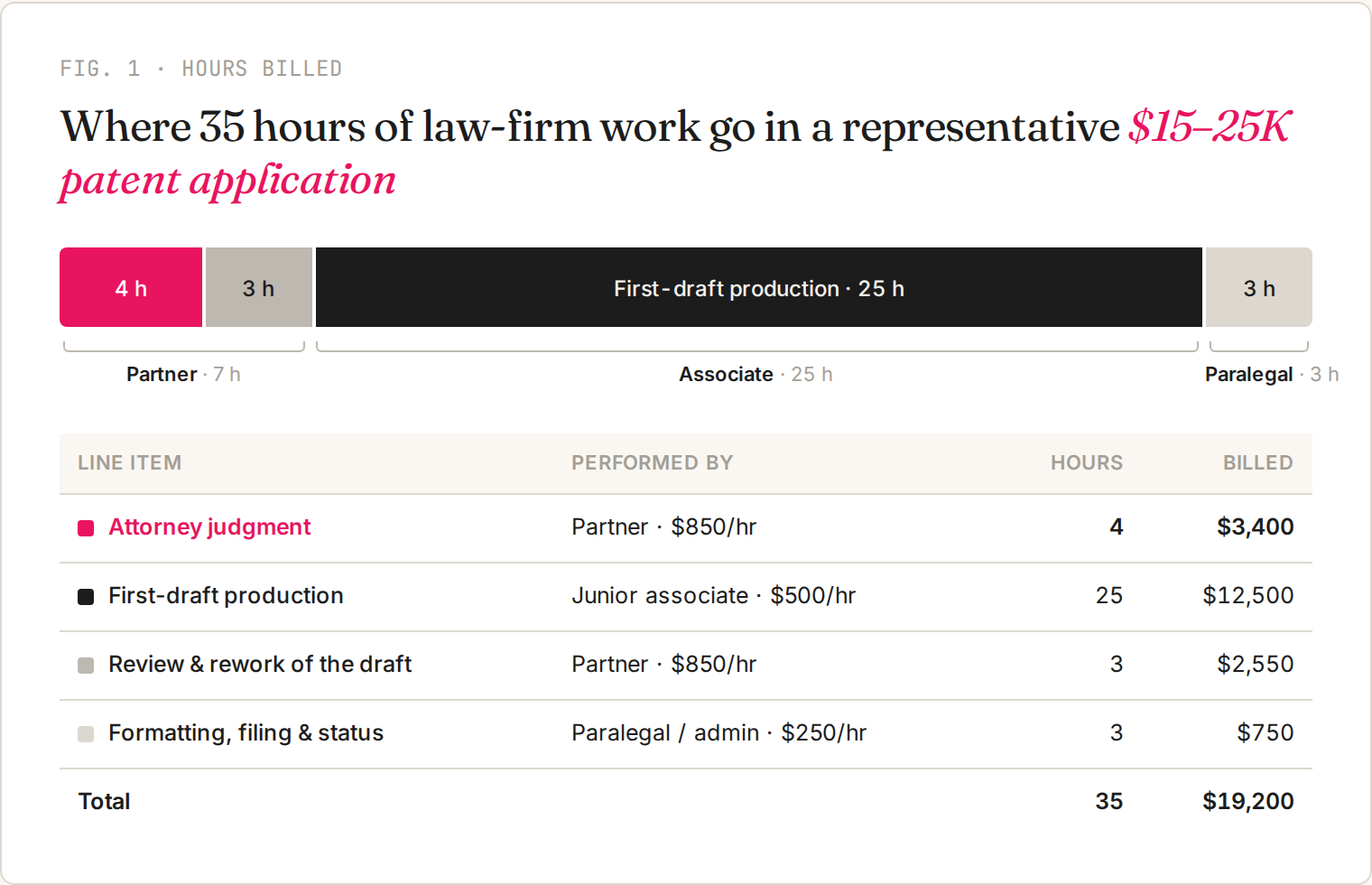
Firms bill the work of lower-cost lawyers at premium rates and pay those lawyers a fraction of what they bill. That spread is the profit engine of the modern law firm, and it has been for a hundred years. In most practice areas the model survives because judgment and drafting are hard to pull apart, and because clients keep paying for both at one blended rate. In patents, clients stopped paying twenty years ago.
Patents are where the model breaks first
The going rate for preparing a patent application has barely moved in nominal dollars since 2007. Adjusted for inflation, that is a two-decade collapse in real prices.
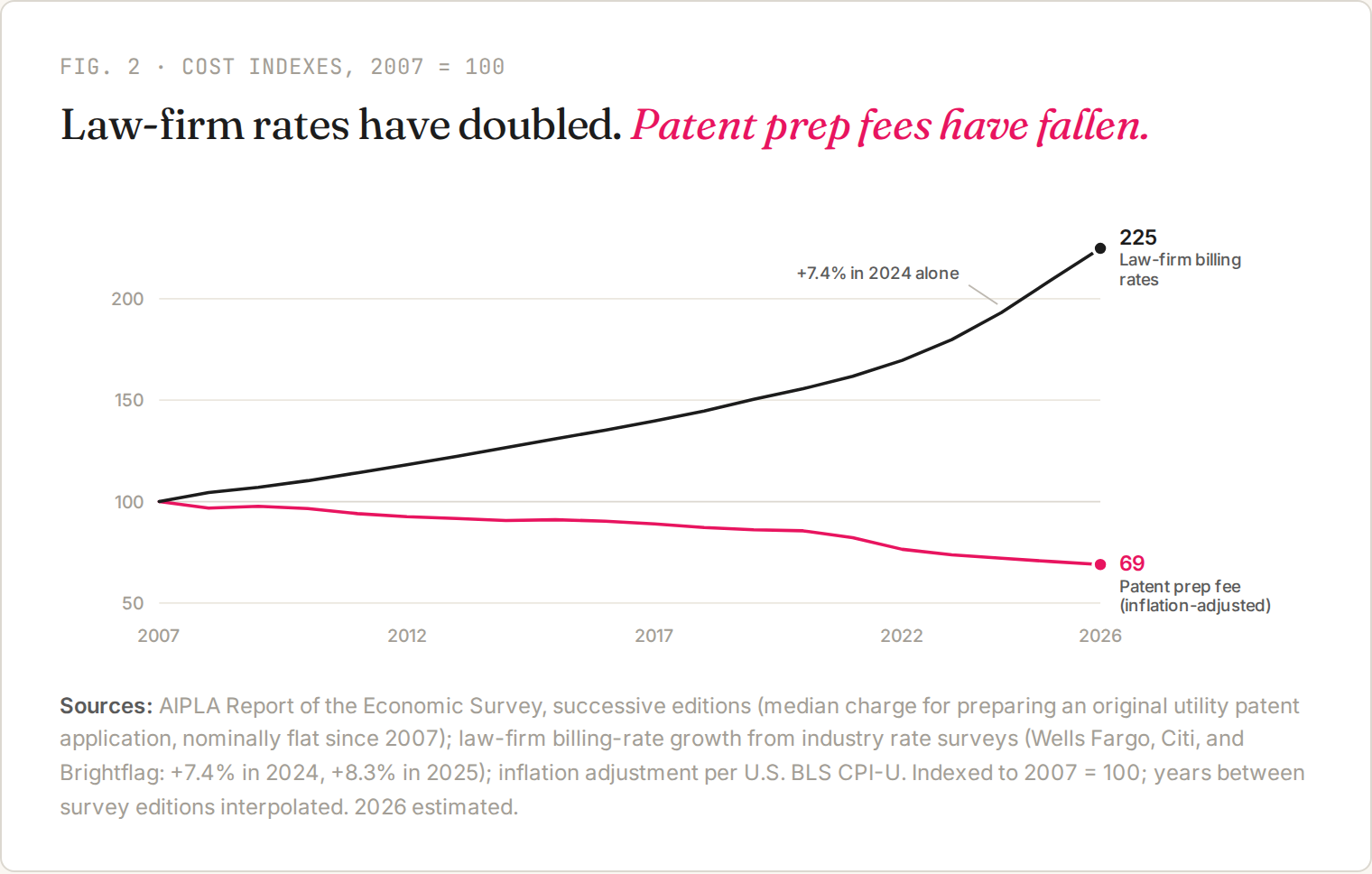
The math doesn't work. Quality demands thirty to forty hours; commodity flat fees fund roughly half that. When the way the work gets done can't change, a firm has one lever left, and that is cheaper hands: more junior hours, less partner attention, sometimes offshore drafting under the firm's letterhead.
At commodity fees, the brand on the engagement letter and the person doing the drafting are no longer the same thing. Price and quality compete inside the same fee, and the client can't see which one is losing.
The people inside the system paid too. Big firms began shedding patent prosecution as unprofitable years ago. Practitioner incomes went flat while rates rose everywhere else in law, and the pipeline of new patent attorneys has thinned to roughly break-even against retirements.
Companies responded the only way they could, with triage. Patentable inventions die in committee every week. They are worth protecting; protecting them costs too much. That is the cost nobody invoices: the moat that never got built.
The price went down. The stakes went up.
While prosecution fees were collapsing, the cost of a weak patent was rising. Most patent claims tested in court since 2014 have died there, and what usually decides survival is the quality of the original drafting, locked in years before anyone knew the patent would matter. Roughly six of every seven applications are rejected at least once, so every application is written under the assumption of rework, for review by an examiner who gets about nineteen hours per case. In 2025 the patent office restructured its fees to penalize slow, drawn-out prosecution.
Nearly 80% of USPTO examiners now use AI-powered search to find prior art. The examiner reading your application is already using these tools. The only open question is whether they will sit on both sides of the table.
The industry fixed the price. Nobody fixed the work.
Alternative fee arrangements were a real win, as far as they went, and the in-house teams who fought for them earned it. But underneath every fixed fee, the work is still done the way it was done in 1980. When the fee squeezes, the only lever is still cheaper hands, and now the squeeze is permanent.
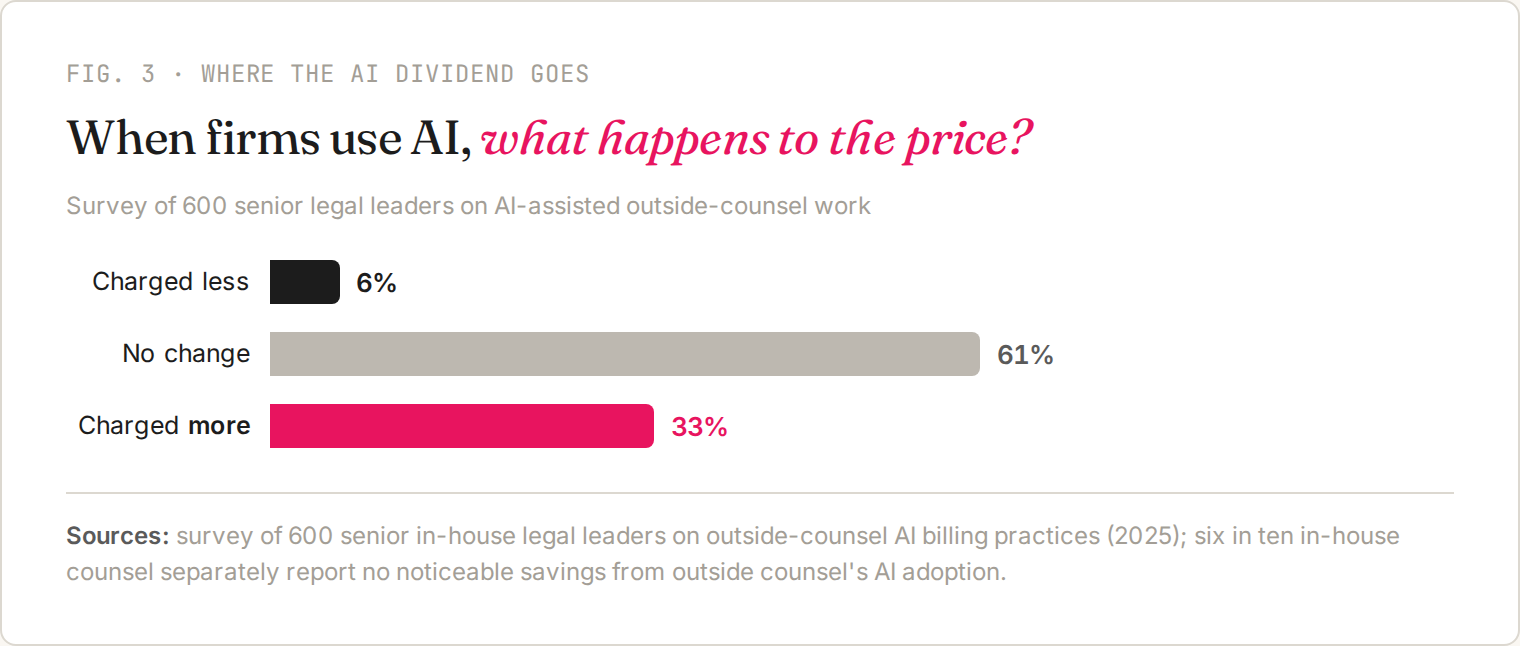
Then firms added AI, and nothing changed for clients. Law firm rates rose 7.4% last year, against 2.8% inflation. In a survey of six hundred senior legal leaders, only 6% of firms charged less for AI-assisted work; a third charged more. Six in ten in-house counsel report no noticeable savings from their outside counsel's AI adoption.
Google measured a 20% efficiency gain from AI-assisted patent drafting and responded by mandating a 30% cut in outside prosecution fees. Most companies can't run that experiment, and their invoices show it.
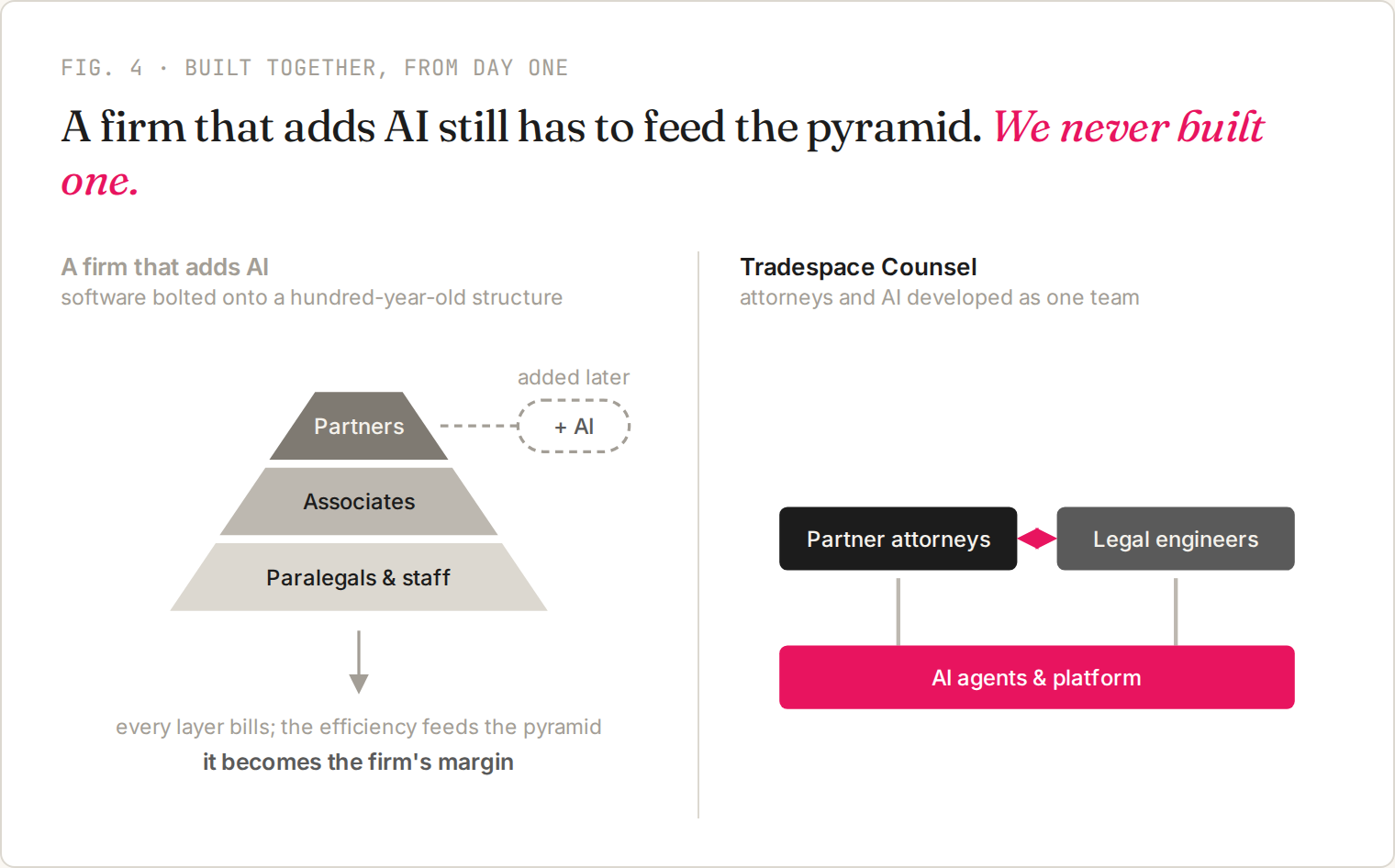
There is no hypocrisy in this; it is arithmetic. A firm that adds AI still has to feed the pyramid. The associate salaries and the partner draws don't disappear because drafting got faster, so the efficiency becomes the firm's margin. The efficiency is real. It's just not yours.
Tradespace Counsel is a different practice model
We built Tradespace Counsel as an AI-native IP practice, one where the attorneys and the AI are developed together from day one rather than a traditional practice with software added later. That order matters more than anything else, because it determines who shapes the technology, what the attorneys' hours go to, and who keeps the efficiency.
Our AI researchers and attorneys work as one team in a feedback loop that runs daily. Attorneys flag where an agent's claim language ran too broad or a search missed a reference, engineers adapt the agents, and the next filing starts from a higher floor. The agents are built into each attorney's specific workflow, shaped by how that attorney practices, and improved by every application that moves through the system.
This goes deeper in IP than in perhaps any other area of law, because patent work has a property most legal work doesn't: the raw material is already written down. The invention lives in the company's technical record, in disclosures, prior filings, engineering documents, and lab notes, and the prior art lives in the public record. An AI-native practice works from all of it. Specifications are built from the complete technical record rather than a two-hour interview. Prior art is searched before claim one is written. Claim sets are checked for support and consistency against the entire specification every time, and office actions are answered with the full prosecution history in context.
It also changes how attorneys spend their days. Our attorneys direct and own the work. They set the claim strategy, shape the draft, press on the risk points, run the inventor conversations, and sign every filing. They no longer spend thirty hours producing the document that carries their judgment. The AI handles the first-pass search, summary, and drafting under their direction, and the attorney's hours go to the decisions that determine whether the patent holds.
We build this way for quality first. The attorney's time goes to your claims instead of being spread across a docket, the draft starts from your full technical record, and the prior art is on the table before the claims are written. The economics follow from the same design. The law firm markup disappears because the brute-force drafting hours disappear, and a partner gets more from a focused set of hours directing and reviewing than the old model ever got from forty hours of manual drafting. We never built a pyramid, so the efficiency lands with you.
Tradespace Counsel is an IP Law Practice, and works like one: your engagement letter, your privilege, and your attorney's professional accountability are what they would be at any firm.
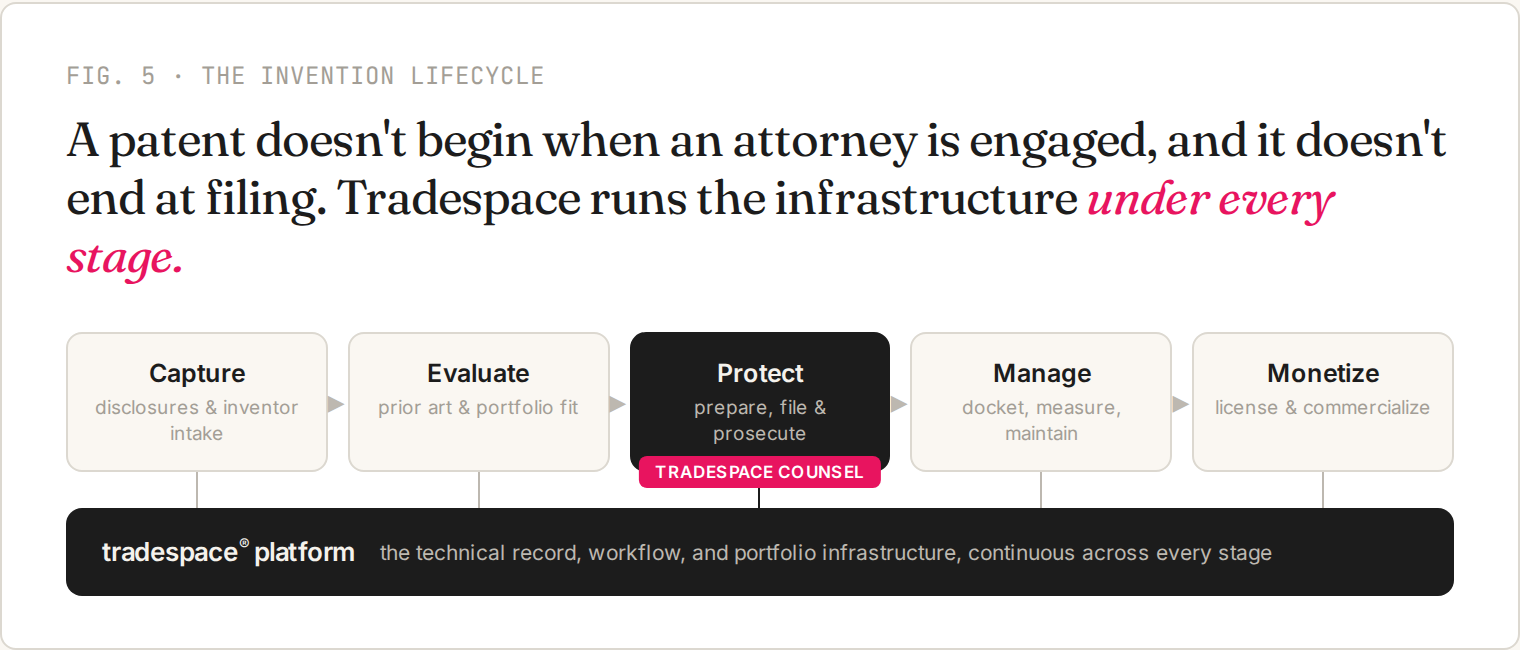
It also matters who builds a practice like this. A patent begins upstream, when an invention is captured and developed, and it lives downstream in a portfolio that has to be managed and defended for twenty years. Tradespace already builds the infrastructure for that whole lifecycle: the systems companies and research institutions use to develop inventions, run disclosures, search prior art, and manage their IP. Counsel is the practice of law added to infrastructure that already holds the technical record the drafts are built from and already runs the workflow the attorneys work in.
How it works
Every engagement starts with an attorney. We match you with a partner-level IP attorney in your technology area, someone you approve before any work begins. That attorney owns your matters end to end: claim strategy, prosecution decisions, inventor relationships, and the signature on every filing. No associates learn on your patent, and nothing competes with your matters for the partner's time.
Onboarding is one working session. Our legal engineers work with you to access your technical documentation and disclosure backlog, your filing preferences, and your docketing setup, whatever you are willing and able to share. We turn that context into style guides, technical briefs, and other artifacts that inform every filing. If you ever add another outside counsel or move away from us, you take those artifacts with you so your applications stay consistent.
The work begins before the interview. By the time your attorney sits down with an inventor, the platform has ingested your technical record and searched the prior art. It has also drafted an initial claim set, figures, and a briefing that covers the strategy, risk points, and open questions. So the interview is no longer a download session where the attorney learns your technology from scratch. The conversation goes straight to what is novel, what is defensible, and what is worth claiming. Inventors give one substantive review per filing.
You see structured outputs at every stage: a prior art search report, a claim strategy brief you approve before drafting begins, a complete application draft with specification, claims, and figures delivered in days, and a filed application prosecuted through allowance by the same attorney who set the strategy.

And you keep the visibility. Every matter runs on the same platform our clients use to manage their portfolios: live status on every filing, flat published fees you can forecast, and performance metrics (cycle time, cost per asset, prosecution statistics) reported by default. No firm can match this, because no firm built its practice on infrastructure that measures itself.
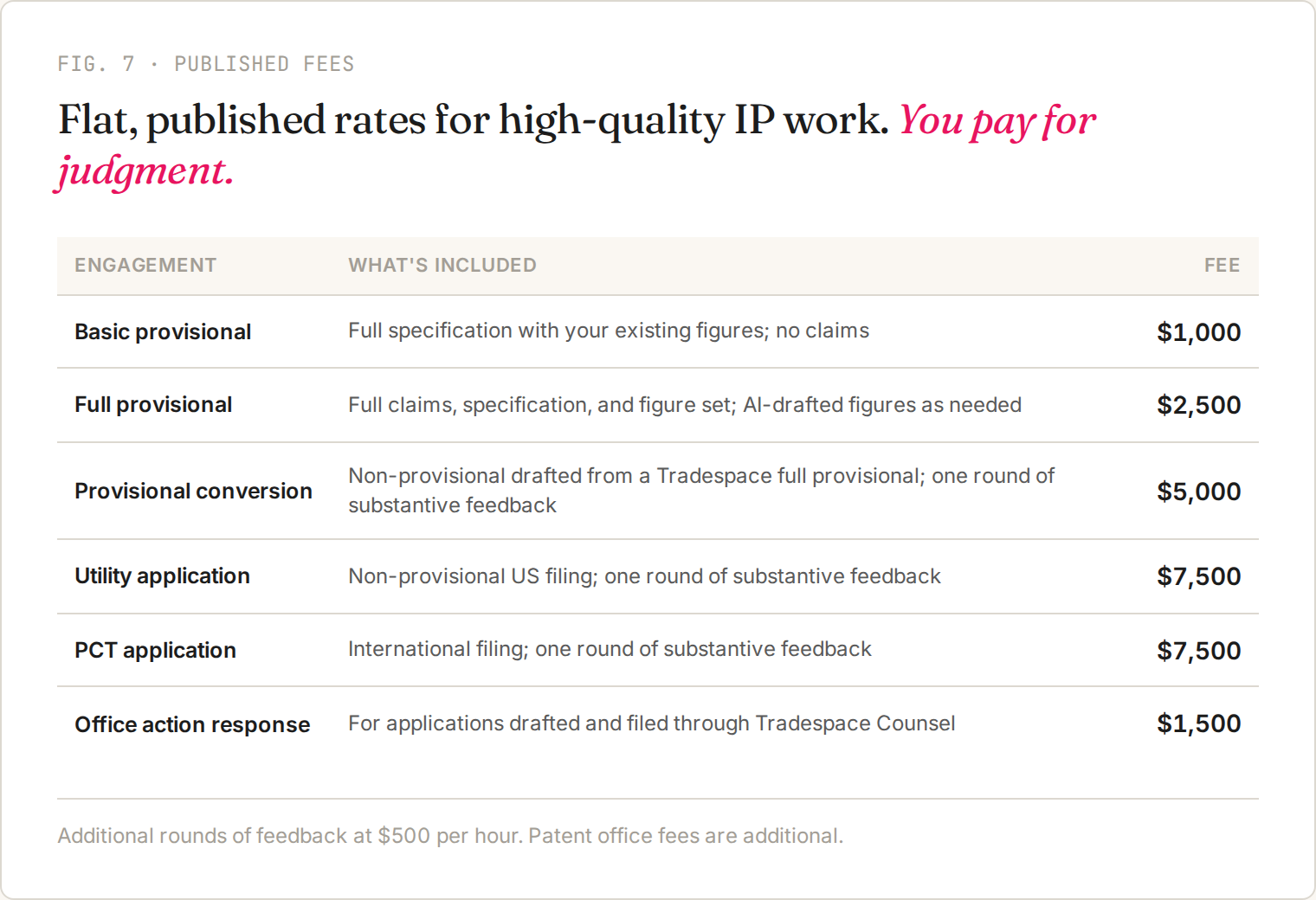
The bar we hold ourselves to is simple. Working with your attorney through Tradespace Counsel should feel better than your current firm relationship, with richer inventor interviews and more visibility, while the invoice and the calendar say something no firm's can.
The standard of care is moving
The definition of lawyer competence in forty states now explicitly includes technology. Within the last decade, e-discovery went from a novelty to something a lawyer must master, delegate, or decline the case over. The profession has already watched, within a single career, a technology become mandatory.
The ABA's first ethics opinion on generative AI holds that when AI does the work faster, a lawyer can't bill for the hours it would have taken. The implication is that honest hourly billing and serious AI use cannot coexist for long. Authorities in the UK have gone further and said that failing to use AI can itself breach a professional's duty.
No American court has said it yet about patents. But the trajectory points one direction, and the facts a future court would need are already in place: the tools exist, they produce better-supported filings at lower cost, and the patent office itself examines with them. When the profession's standard catches up to its technology, hand-drafting a patent won't look artisanal. It will look like negligence.
(Our senior counsel will make the practitioner's version of this argument, with the citations, in a companion piece.)
What this means for the firms you already trust
So what happens to the firms you have worked with for years, the ones that know your business and your technology? You keep them. The partner who has known your technology for a decade is valuable, and the matters where that history is the asset should stay where the history lives: litigation, licensing negotiations, the bet-the-company strategy questions. The speed and savings you gain with Tradespace Counsel let you build a deeper bench, with more than one option for IP work.
But don't mistake context for quality. Notice where that decade of context lives: in your documents, your prior filings, your disclosures. Our platform ingests all of it before the attorney starts. Ten years of context is valuable. It is also, increasingly, loadable.
Where the money should go
Fixing prosecution is the beginning of a better approach to IP, and the result is a legal budget sorted by what each dollar buys. Every dollar freed from commoditized filing work can move to where judgment and risk transfer earn premium rates: IP strategy, litigation, and licensing, where the right counsel changes the outcome. The point was never smaller legal budgets. The point is legal budgets spent on judgment.
So here is my commitment to you as we roll out Tradespace Counsel. First, the efficiency belongs to you. Fees are flat and published, priced off how the work is done, and they fall as the cost of our work goes down. Second, judgment and strategy stay with attorneys. A named, partner-level attorney owns every filing end to end, with more time per filing than the old model ever gave them.
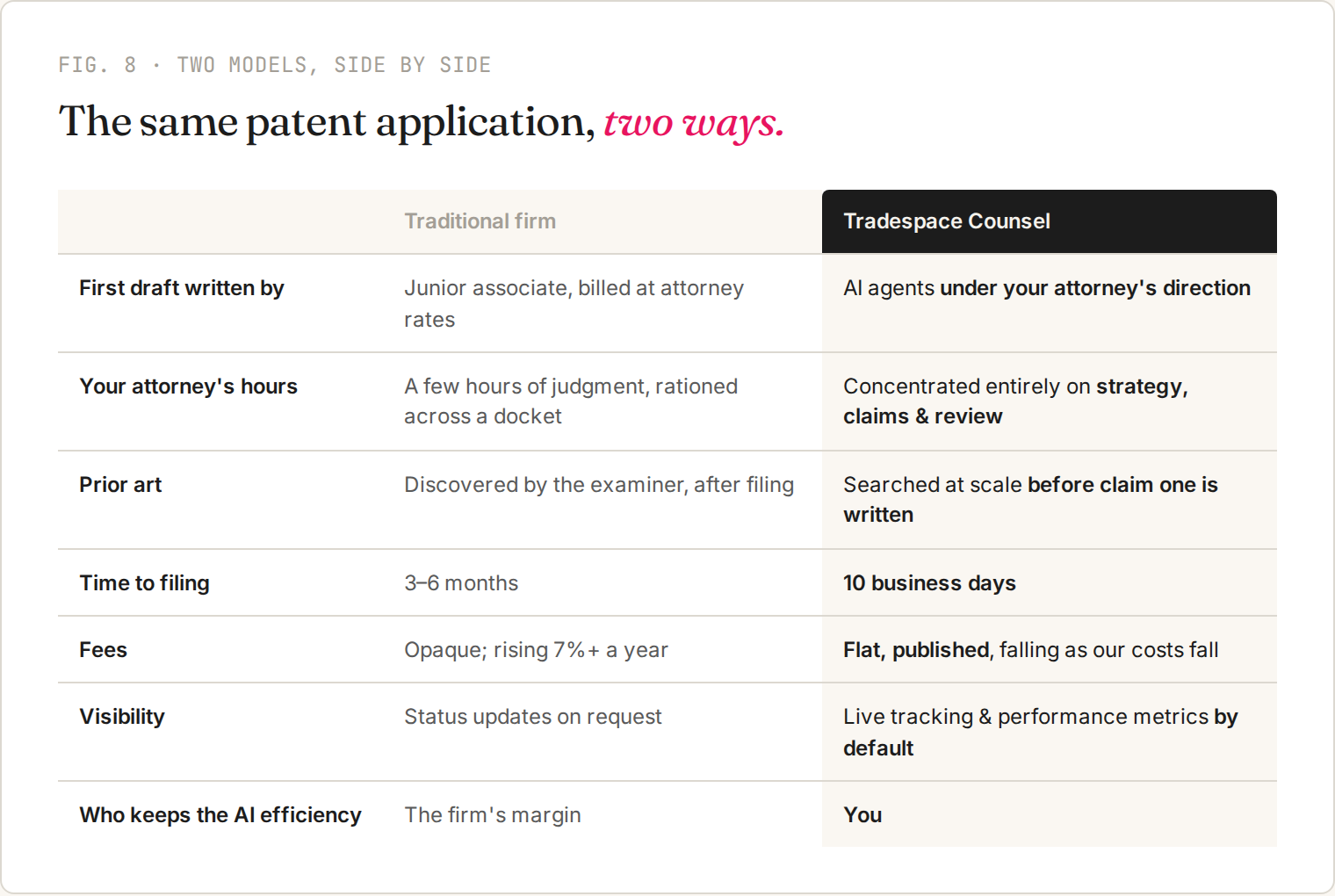
We don't ask anyone to take this on faith. Patents are the rare legal product where you don't have to. The work is written down and the outcomes are measurable. Hand us one disclosure from your backlog. Put our draft next to your current firm's. Judge both on the standard you already use.
Williams's line carried a condition that is easy to miss. A machine made of words has no part that is redundant; everything in it has to do work. Every good patent attorney already brings that discipline to a claim set. The industry never brought it to the practice itself, where whole layers exist to be fed and the client pays for hours that do nothing for the patent. Tradespace Counsel holds the practice to the standard of its product. The attorney's hours go to judgment, the agents carry the drafting, the platform holds the record and measures the result, and nothing in between is there because it always was. Somewhere in your company right now is an invention that will die in committee this quarter because protecting it costs too much. We built this so that it doesn't have to.
A patent is a machine made of words. So is the practice that builds it.
Alec Sorensen
Founder & CEO, Tradespace
Notes
- William Carlos Williams, author's introduction to The Wedge (Cummington Press, 1944): "A poem is a small (or large) machine made of words."
- AIPLA, Report of the Economic Survey, successive editions; median charge for preparing an original utility patent application, nominally flat since 2007.
- Alex Su, "What Clients Are Really Paying For," Off the Record.