

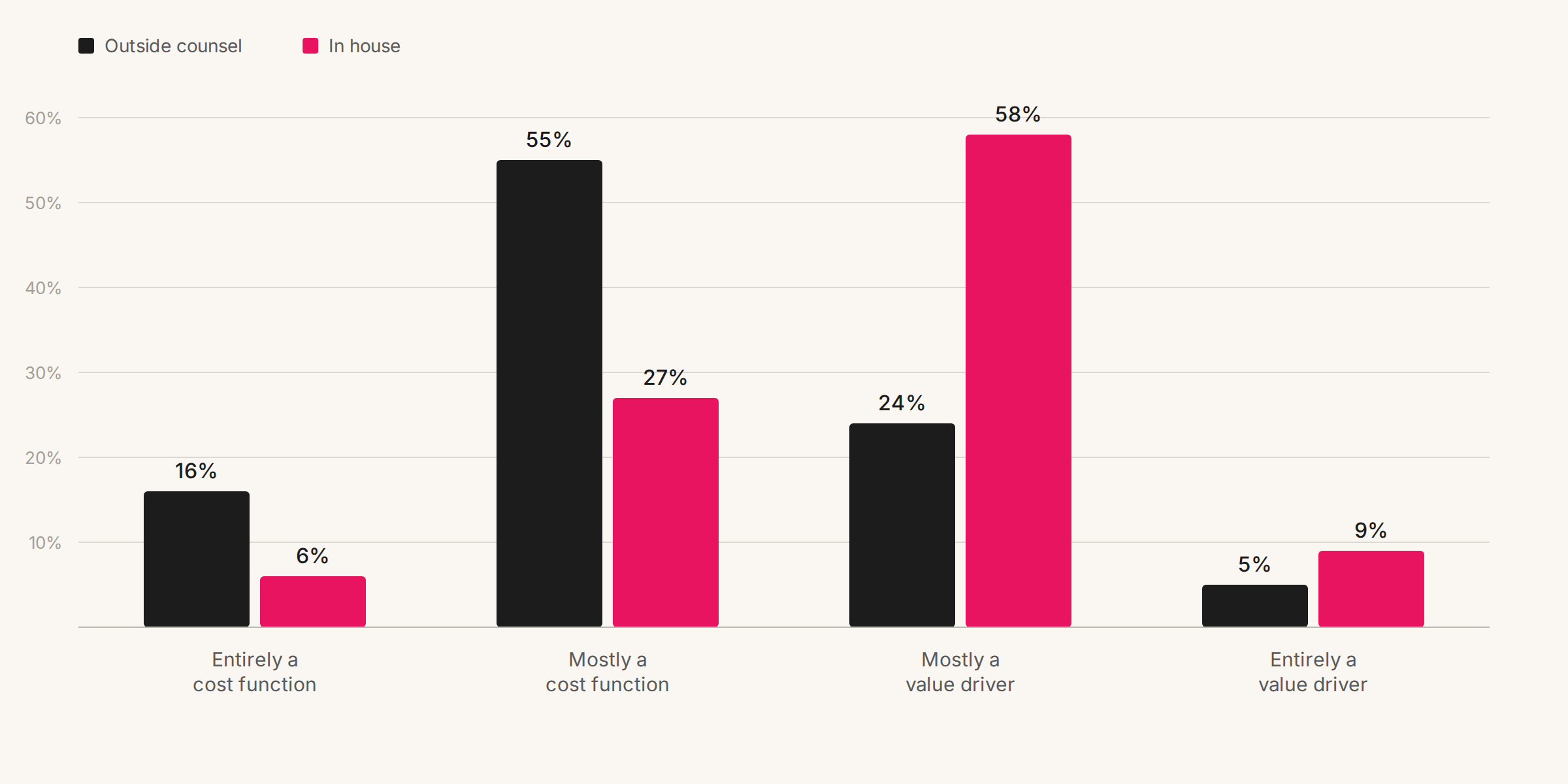
- Companies where the majority of IP work is done in-house hold a consistently more favorable view of IP as a value driver.
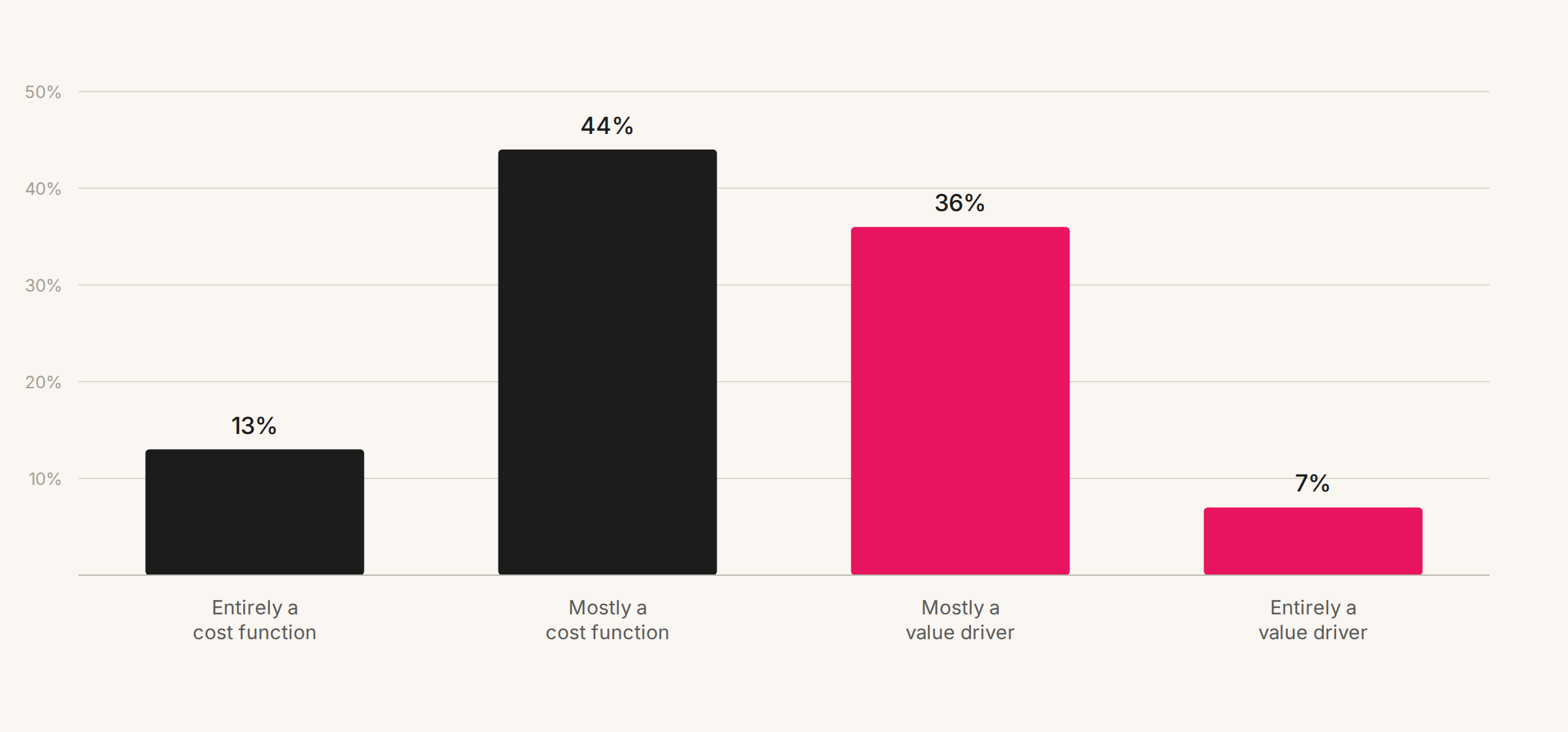
- 57 percent of respondents regard IP as a cost function despite increased adoption of new service delivery models for outsourcing like fixed fee and Alternative Legal Service Providers (ALSPs).
- Understaffing is an issue for many IP teams, particularly those managing large portfolios.
- Most respondents expect their organizations to invest in technology to improve their IP management within the next three to five years
In the age of artificial intelligence, in-house patent management is entering a period of structural change. The number of published patent applications reached record levels in 2024, as reported by Insights by GreyB, while the U.S. Patent and Trademark Office continued to face chronic delays in examination. The result is a snowballing backlog of pending applications and a widening gap between filings and grants, and within this environment, in-house legal departments face increasing pressure.
Yet even as this pressure mounts, emerging AI tools may offer a solution, giving in-house teams new leverage to manage growing workloads. AI can increase the speed and volume of invention disclosures, improve the detection of potential infringement, expand the need for comprehensive freedom-to-operate analyses, and intensify the expectation that legal teams integrate their decision-making with broader business goals.
In September 2025, Above the Law and Tradespace surveyed more than one hundred in-house IP leaders to understand team structure, resource allocation, and organizational attitudes toward intellectual property. The findings indicate a strong relationship between the degree to which organizations handle patent drafting and prosecution internally and the degree to which they view IP as a contributor to growth: organizations that internalize more patent work tend to view their portfolios as engines of value.
AI is enabling IP teams to turn speed and scale into a competitive advantage for the broader business. Specifically, forward-leaning IP teams are realizing they can drive competitive advantage in four distinct ways:
- Harvesting more innovation
- Getting from idea to patent application faster
- Drafting high-quality claims that better support the company’s strategic goals
- Identifying infringement at scale
Toward a real shift in perception
The longstanding perception of IP as a cost center has persisted through shifts in technology and business practice, including cloud adoption, the rise of ALSPs, and work-from-home reductions in overheads and staffing. The emergence of AI may be the first change significant enough to alter this perception permanently. Although many in-house patent teams remain lean, AI-enabled tools can stabilize workloads by automating portions of drafting and prosecution. These tools now present an opportunity for even the smallest legal departments to assume a more active role in patent management and take advantage of this outcome.
Our survey data show that two-thirds of companies that draft patents in-house describe IP as a value driver. By contrast, 71 percent of companies that outsource drafting identify IP as a cost. These competing views reflect how structure shapes perception: internal teams develop closer relationships with product leaders and technical contributors, which strengthens the connection between IP activity and corporate strategy.
Value tracks with in-house work
The most consistent pattern in the study is the relationship between internal patent work and strategic recognition. When drafting and prosecution occur inside the organization, IP is treated as a source of advantage. Where these functions remain external, IP is described as a necessary expense. Two explanations are plausible. First, organizations with strong innovation programs may be more inclined to build internal capability, hire attorneys with relevant technical experience, and integrate IP into engineering and R&D. Alternatively, in-house teams may adopt a more strategic perspective as collaboration with technical teams increases. Although the causal direction may differ, the practical effect is the same: whether strategy leads to internalization or internalization strengthens strategy, bringing drafting and prosecution in-house is consistently associated with a more value-oriented IP function.
High-growth startups: the early scale squeeze
Companies with annual revenue between $51 million and $499 million, often high-growth startups, report the lowest satisfaction with staffing ratios. These organizations may be expanding engineering faster than they expand legal resources, or have not yet adopted the workflows or technology platforms that larger companies rely on. As invention review demands and filings increase, startup IP needs may outstrip internal capacity.

As a result, many of these companies experience a scale squeeze that affects efficiency and planning. This strain is reflected directly in practitioner experiences, and it underscores how even seasoned teams feel capacity limitations long before leadership recognizes the bottlenecks.
“Our IP legal group of six people (four attorneys, two patent specialists) is a very lean team relative to most departments in the company. We have a large spectrum of responsibility and push ourselves every day to meet all of our obligations.”
— IP manager, manufacturing company
The mid-market scale squeeze
In the next revenue band, $500 million to $999 million, staffing satisfaction improves modestly. Mid-market companies often ease early-stage pressure by shifting more drafting and prosecution work to outside counsel, which provides short-term stability but reduces contact between in-house counsel and inventors. As more work moves outside, distance between in-house teams and product teams grows, and IP becomes less connected to business strategy. This separation correlates with a diminished view of IP as a strategic asset.
The portfolio plateau at 1,000 patents
Portfolio size and team size rise together for a period, but growth in headcount slows once portfolios reach about 1,000 assets. Workloads, however, continue to increase through five channels, including invention disclosures, foreign filings, office actions, maintenance decisions, and collaboration with engineering. This leveling off may indicate that teams are benefiting from economies of scale, operating with a lower ratio of in-house employees to patents as portfolios grow. Larger companies may also rely more heavily on outside counsel, which can reduce pressure on internal staff.

It is also likely that legal teams are absorbing rising workloads without corresponding increases in resources, which can contribute to burnout and reduced morale. This explanation is especially plausible given that organizations with the largest portfolios reported high levels of understaffing. The data suggest that sustainable portfolio expansion depends on systems that help teams manage rising volumes without sacrificing clarity or accuracy, especially once portfolios pass the thresholds where staffing levels plateau.
Technology as a force multiplier and predictor
A majority of surveyed organizations expect to invest in IP technology within the next three to five years. Respondents noted five expected benefits: shorter drafting cycles, improved accuracy, clearer portfolio intelligence, stronger coordination with product teams, and more predictable review processes. This expected shift toward automation is already influencing strategic planning. As the deputy general counsel of one large technology company observed, organizations will place “increased focus on using AI to increase efficiency and quality of patents while reducing costs.”
Organizations that view IP as a source of value are more likely to invest in emerging technology, and among organizations that already perform significant patent work in-house, technology is identified as the factor that enables higher throughput and stronger collaboration. Multiple respondents emphasized that technology is not only changing workflows, but also redefining the role of the IP manager.
“IP managers will have substantial influence in the direction of revenue growth.”
— General counsel, small technology company
Another IP leader expects the role to broaden further “to integrate multiple areas of expertise and technical know-how in addition to legal acumen.” As AI tools reshape drafting and prosecution, in-house attorneys will require deeper fluency with evolving systems, and, as another respondent notes, IP leaders “will need to understand AI, including its strengths and weaknesses, and drive beneficial use of AI by our outside counsel.”
Survey data points suggest that technology adoption may be the bridge supporting enterprise transition from cost containment to value creation. Once companies begin viewing IP as a valuable strategic asset, they are more willing to invest in technological solutions that support in-house teams and relieve the burdens of rote and repetitive work. This, in turn, encourages a virtuous cycle of team efficiency, portfolio growth, asset leveraging, and keen strategizing. Technology adoption thus serves as an indicator of organizational maturity, reflecting a willingness to formalize processes, strengthen internal controls, and shift decision-making from reactive management to deliberate planning.
Conclusion
AI presents a realistic opportunity to finally challenge the longstanding perception of patents as a cost center. Several conditions are converging to make this moment different than previous technological evolutions. First, big law firms now face competition from smaller, lower cost counterparts as AI places downward pressure on rates. Second, at the same time, the number of patent applications is accelerating as generative AI tools expand the speed and volume of invention activity. Filing costs and the need for competent counsel will moderate the steepness of this growth curve, but the overall trend points toward increased volume and greater pressure on in-house teams.
If these workloads continue to grow while IP is still viewed as a cost center, and if legal departments are denied the resources required to keep pace, the system will experience significant strain. Our survey results suggest a definitive path forward. Organizations that can bring more drafting and prosecution in-house may develop a stronger strategic orientation toward their portfolios, see closer collaboration with product and engineering teams, and achieve clearer alignment between innovation and legal strategy. Internalization is also associated with more deliberate decision-making and stronger returns on patent investment.
Technology plays an important role in supporting this shift. AI-enabled tools allow lean legal departments to automate portions of mechanical drafting, improve consistency, maintain quality during periods of scale, and create the conditions necessary for sustained internal self-reliance. These tools also help stabilize workloads as portfolios expand, particularly once companies reach the thresholds where staffing levels begin to plateau. By reducing dependency on outside counsel and improving internal visibility, legal technology allows organizations to convert IP activity into a source of efficiency and commercial leverage.
The combined trends suggest that operating model decisions are no longer administrative choices, but rather strategic determinations about how an organization manages growth and protects innovation. Bringing drafting and prosecution inside the company, supported by modern technology and clear processes, allows legal departments to shift from reactive management to forward planning. As a result, IP-related legal technology should be treated as a core component of any contemporary law department’s strategic outlook. The organizations that act on these insights will be better prepared to meet rising patent volumes, navigate changes in the legal services market, and transform their IP portfolios into active drivers of enterprise value.