

- Corporate demand for university IP has become less predictable, pushing TTOs toward spinouts and more direct commercialization.
- Novelty is not a market: substantiate every yes or no with objective evidence and understood decision criteria.
- Estimate the return to the university and the probability of achieving it before investing or filing.
- A stage-gated patent strategy lets offices defer the most expensive phase for up to 30 months while an idea proves out.
- Chasing down inventors early balances diligence with speed and lets inventions benefit from feedback during development.
The traditional university licensing model is changing. As corporate demand for university IP has become less predictable and less reliable, universities have had to explore other avenues for technology transition, including spinning out technology into new companies. Playing this role in the venture ecosystem requires universities to adjust their technology evaluation process and criteria. Upfront commercial due diligence of ideas is critical, and will help universities make better decisions about IP and where they invest their resources. Below are five key shifts that tech transfer offices might consider as commercialization goes more direct.
1. Don’t fall in love with the technology
Just because it’s new doesn’t mean there’s a market. Universities now have to ask, “Does this idea have commercial potential?” As such, IP teams need to be able to look past the technical allure of ideas while thinking about whether they’ll drive value. This requirement also means resisting the influence of charismatic inventors who may believe intensely in the merits of their ideas. And unless we’re to lose the support of these passionate inventors, it’s equally important to substantiate a “no” decision with objective evidence and a decision process with understood decision criteria.
2. Evaluate the potential ROI before making investment or patent decisions
The commercial merits of technology should be a key driver in the evaluation process. A university’s mission is, among other things, to transfer technology and make an impact. But transferring technology to a spinout or corporate partner only happens if it provides an attractive business case to the partner. Before investing in a new technology, a university should consider the technology’s potential ROI (which is more like a business case), and itself is a function of several questions:
- What is the potential return to the university?
- What is the probability of that return?
There are several types of returns a university might realize, and which types matter most will vary by university. It could be simple economic outcomes: how much licensing revenue did the university realize? Or how many jobs did the license lead to in the university’s region? But these metrics can require a longer time horizon to evaluate well. It could be a nearer-term metric such as number of deals done, achieving a desired ratio of spinout vs. corporate license, etc.
So before making an investment in a piece of technology, estimate the ROI and make an assumption about how it’ll be realized (spinout vs. license), and the probability of that ROI happening.
3. Estimate the probability that the technology will achieve its estimated return
Each university should develop its own structured decision criteria for evaluating the probability of generating a return, but several variables to consider include:
- General maturity of the technology (TRL) — How much more work remains to be done to take the technology to market?
- Technical complexity and predictability — What is the probability that the technology will work as intended? What is the probability that a high TRL can be attained?
- Cost of development — How much investment will it take to bring to market? Note that cost alone isn’t necessarily a problem if the payoff is there, but a high cost may suggest that partnering with a well-resourced company may be better than a spinout.
- Size, predictability and growth rate of the market — Who is the customer, how many are there, and what is their demand? Are there multiple potential markets or use cases for the technology?
- Patentability — How well can the technology and the future revenue be defended by patent? This might be an important criterion for a for-profit entity considering a license.
- Regulatory complexity — Is the market highly regulated? Pharmaceuticals and medical devices, for example, will carry their own complexity that may require an experienced partner to bring to market.
It may be difficult to do this in confident detail at the time of disclosure, which brings us to our next shift.
4. Embrace a stage-gated investment process
Innovation is an inherently risky process. Many successful organizations use a disciplined stage-gated process to limit financial loss. They don’t commit all investment resources upfront; instead, they invest more and more in an idea as its risk profile improves (through, for example, gated reviews that address technical and market feasibility). The process also informs when it is time to abandon an idea, and stop spending “good money after bad.”
Just like a new innovation initiative will be unclear at the outset, so too will be the potential of technology disclosed to the technology transfer office. Consider creating your own stage-gated process for increasing your investments as an idea becomes de-risked.
When it comes to limiting financial loss, universities are likely most concerned about time and actual expenses. Time carries a tremendous opportunity cost for most offices, so they may want criteria to help their often too-small teams make smart decisions about how they spend their time. Expenses are key too, and usually manifest in the form of attorneys fees and patent filing expenses. The patent system actually provides excellent options for universities to incrementally invest in patenting as an idea proves out. With a good strategy, the most expensive phase of patenting can often be deferred for 30 months. As you create a stage-gated process, consider the elements of a patent strategy (e.g. provisional, utility, PCT, national phase, continuations) and the decision criteria for approving the incrementally more expensive patent stages.
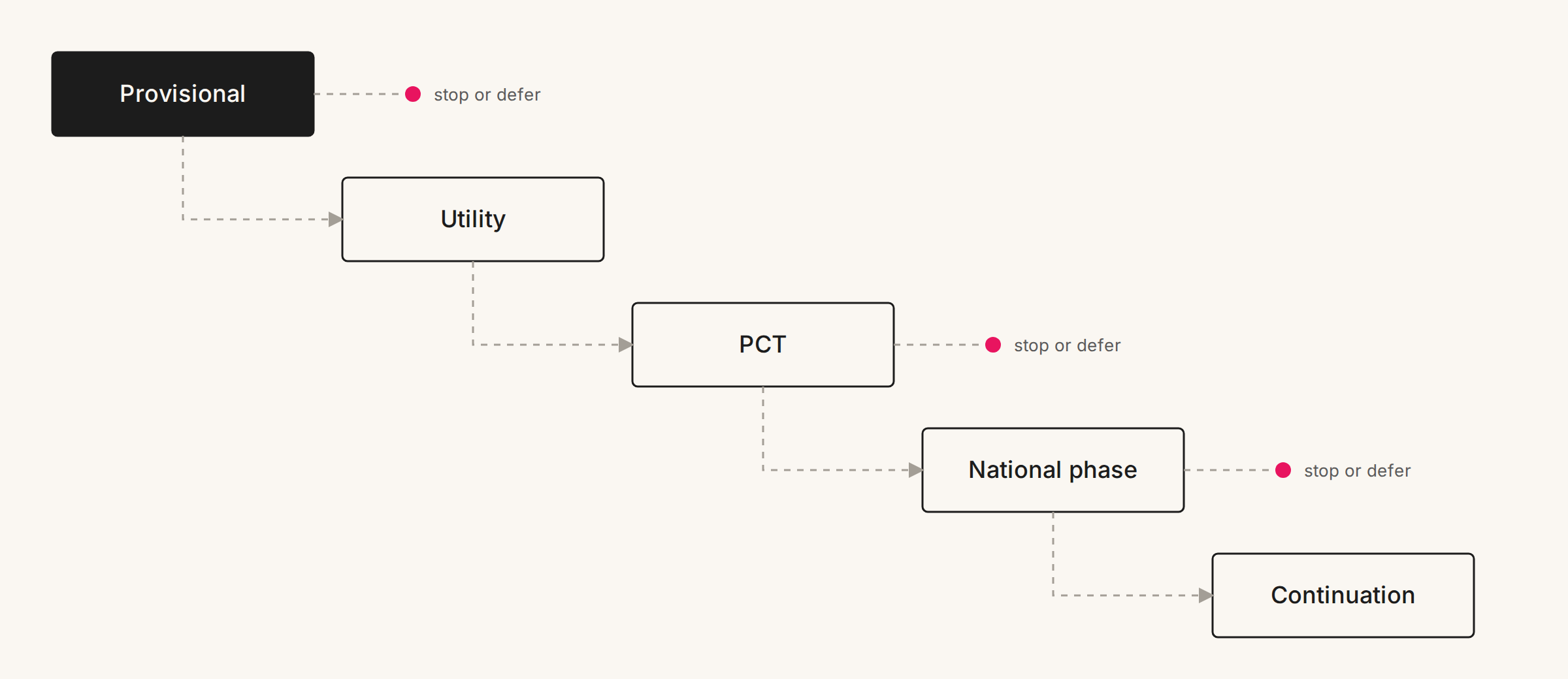
Also consider techniques for further deferring investment costs within the individual patent stages. Think creatively about the utility stage: launching a utility doesn’t automatically mean assuming the full cost of a utility. You might be facing a deadline, yet not have all the information you want. Reasonable minds can disagree on these points, but there are ways to stage investments in a utility. You might file an application with informal drawings, or maybe an abbreviated list of claims. Both of these can often be remedied later without impairing the application. In both cases, you’ll buy yourself at least a few months before you have to take those next steps and incur the cost. Work with counsel who is willing to understand your goals and constraints, and who will offer you creative solutions.
5. Chase down inventors instead of waiting for them
A problem with front-loading commercial due diligence is that it can take a long time to do it right — and we don’t always have the time to do it well (because of constraints like statutory filing deadlines, for example). To balance diligence and speed, get feelers for what researchers are working on — and industry interest — early on. Being proactive not only saves time, but also lets your inventions benefit from feedback during the development process.
By embracing these shifts to bring more commercial scrutiny and proactivity to university patents, universities can continue to bring breakthroughs to the market despite slowed-down demand for corporate licensing.